TIPM fuel pump relay failure: prove it at fuse M25 first
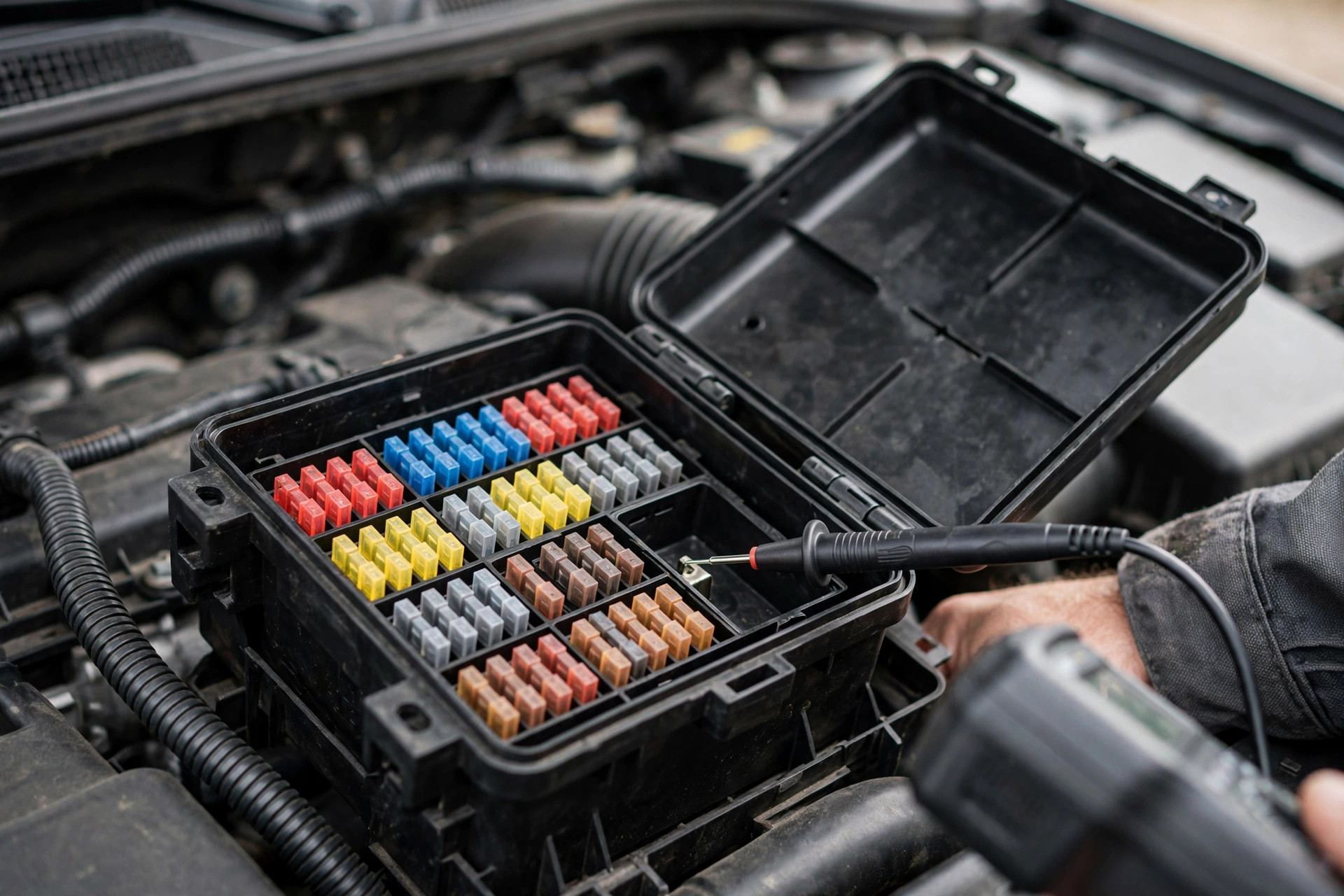
The van cranks strongly and will not start, as if the tank were empty. Or it starts on the second or third attempt, worst on cold mornings, then runs fine all day. Or it stalls at a light, restarts, and gives no warning the next time. And in the strangest version, you shut the van off and can still hear a faint hum from the rear — the fuel pump, still running, quietly draining the battery overnight. On 2008-and-later Grand Caravans these are the classic fingerprints of one small part: the fuel pump relay. The catch is where that relay lives. It is not a plug-in cube in the fuse box that you can swap in the driveway. It is soldered to a circuit board deep inside the TIPM — the Totally Integrated Power Module, the under-hood fuse box itself — on the TIPM-7 design used across these vans. A failed relay therefore presents owners with quotes for a fuel pump, or for an entire TIPM, before anyone has proven the relay is even the problem. This guide proves it first, with one fuse and a multimeter, then prices the honest repair options.
Why this failure pattern looks the way it does
A relay is a switch, and a worn switch fails intermittently before it fails completely. Contacts that are pitted or a coil that weakens with temperature explain the whole symptom list: hard starting when cold that improves as the van warms, starts-and-dies episodes, stuttering or stalling while driving as power to the pump drops out, and the relay sticking in the on position so the pump runs after shutdown and flattens the battery. The failure typically worsens over time until no power reaches the pump at all. Two look-alikes must stay on the table until the test is done: an actually failing fuel pump produces similar no-start behaviour, and a weak battery or starter problem produces slow cranking, which is a different sound entirely — this relay failure cranks at full speed. The test below separates relay from pump in about five minutes, which is why doing it before ordering anything matters: a pump replacement is a tank-down job, and a TIPM replacement is a four-figure dealer visit, while a relay diagnosis costs a multimeter reading.
Prove it at fuse M25: the tested procedure
- Confirm the fuse map. Open the TIPM lid under the hood and read the diagram inside it. On these vans the fuel pump fuse is M25, a 20-amp fuse — verify it against your own lid, because the test is meaningless at the wrong slot.
- Know the normal behaviour first. Turn the key to On without cranking. The pump should run for about the first 2 seconds — the prime — then stop. That pause is normal design, not a fault.
- Measure at M25 while cranking. With a multimeter or test light on the M25 fuse circuit, have a helper crank the engine. While cranking, and whenever the engine runs, that circuit should show a constant 12 volts, because the relay must feed the pump continuously.
- Read the result. Constant 12 volts while cranking, with a no-start, moves suspicion downstream to the pump itself and its wiring. Voltage that is missing, intermittent, or drops out while cranking — on a van with the symptom pattern above — is the failed internal relay caught in the act.
- Cross-check the pump directly (optional, decisive). A test cable can feed the pump from a known 12-volt source: one end in the M25 slot, the other in the right-hand terminals of the M7 power-adapter fuse slot, which carry 12 volts with the vehicle on or off. In a quiet place, a healthy pump is audible near the fuel tank. A pump that runs strongly on direct power, on a van that will not start through the relay, closes the case.
- Check for the stuck-on version too. After shutdown, listen at the rear of the van and check again in ten minutes. A pump still running with the van off is a relay stuck closed — and the explanation for a battery that keeps going flat with no other cause found.
What success looks like: you have a recorded result — constant 12 volts at M25 while cranking, or a documented drop-out — plus a pump that either runs on direct power or does not. One of those two outcomes names the faulty part before any money is spent.
The repair ladder, priced
Prices below are dated 2026-10-16 and come from Vertical Visions, the specialist maker whose test cables and plug-in systems dominate this repair niche; treat them as a snapshot for comparing the rungs against each other, not as quotes.
| Option | Price (USD, 2026-10-16) | Time | Long-term? |
|---|---|---|---|
| Bypass / test cable | $25–36 | 5–10 minutes | No — a test tool and a get-you-home measure |
| Plug-in relay system (Lite) | $59 | 3–5 minutes | Yes, with the safety note below |
| Plug-in relay system (ASD) | $99 | About 5 minutes | Yes — preserves crash fuel-cutoff behaviour |
| TIPM repair (board-level relay replacement) | $299 | 30–60 minutes, after days of vehicle downtime for shipping | Yes |
| External relay fitted by a dealer | $400–600 | 1–2 hours | Partial — external relays are reported to fail again within a few years |
| New TIPM | $1,500+ | 1–3 hours plus dealer programming (around $100+ labour) | Yes |
Read the ladder with the safety distinction in view. Simple bypass cables and the Lite plug-in system are key-on, power-on devices: the Lite's own product page states that it does not interact with the vehicle's automatic shutdown features, which cut fuel pump power after a crash when the engine stops rotating, while the ASD plug-in version does preserve that behaviour. That single difference is the honest reason the ASD version costs more, and it is the detail reseller listings for cheap bypass cables never mention. The decision framework is therefore: use a cable to test and to get home; choose between the plug-in systems with the crash-cutoff question answered deliberately, not by default; consider board-level TIPM repair — replacing the soldered relay itself, a job for a specialist service unless your soldering is genuinely good — if you want the original module kept; and reserve a new TIPM for vans with multiple TIPM faults beyond the fuel pump relay, where fixing one circuit no longer makes sense.
Fitting a plug-in system is deliberately unskilled work: on the common design, the M25 and M37 fuses move into the unit and the unit plugs into the TIPM in their place, a few minutes with no cutting, no TIPM removal, and no programming. Whatever rung you choose, re-run the M25 test afterward and then live with the van through several cold starts before calling it fixed — intermittent faults are only proven gone by the conditions that used to provoke them.
Frequently asked questions
Can I just replace the fuel pump relay? Not as a plug-in part. On the TIPM-7 fuse box the relay is soldered to one of six circuit boards inside the module. Replacing it means board-level desoldering and soldering, which is why bypass, plug-in, and repair-service options exist.
Is a bypass cable a permanent fix? No. The specialist maker rates its own bypass cable as not a long-term solution — it is a testing tool that can also keep the van running. Long-term rungs are the plug-in relay systems, a TIPM repair, or a new TIPM.
Why does the van start fine with starting fluid? Because the engine, ignition, and compression are working and only fuel delivery is missing — a useful early clue that points at the pump circuit, and one more reason to run the M25 test before buying a pump.
Owner information only, not professional mechanical advice. Fuel-system and electrical work carries fire and injury risk; if you are not confident working in a live fuse box, have a qualified technician run the test — it takes minutes and the result is what you are paying for.