ABS wheel speed sensor diagnosis: prove the corner before you replace the sensor
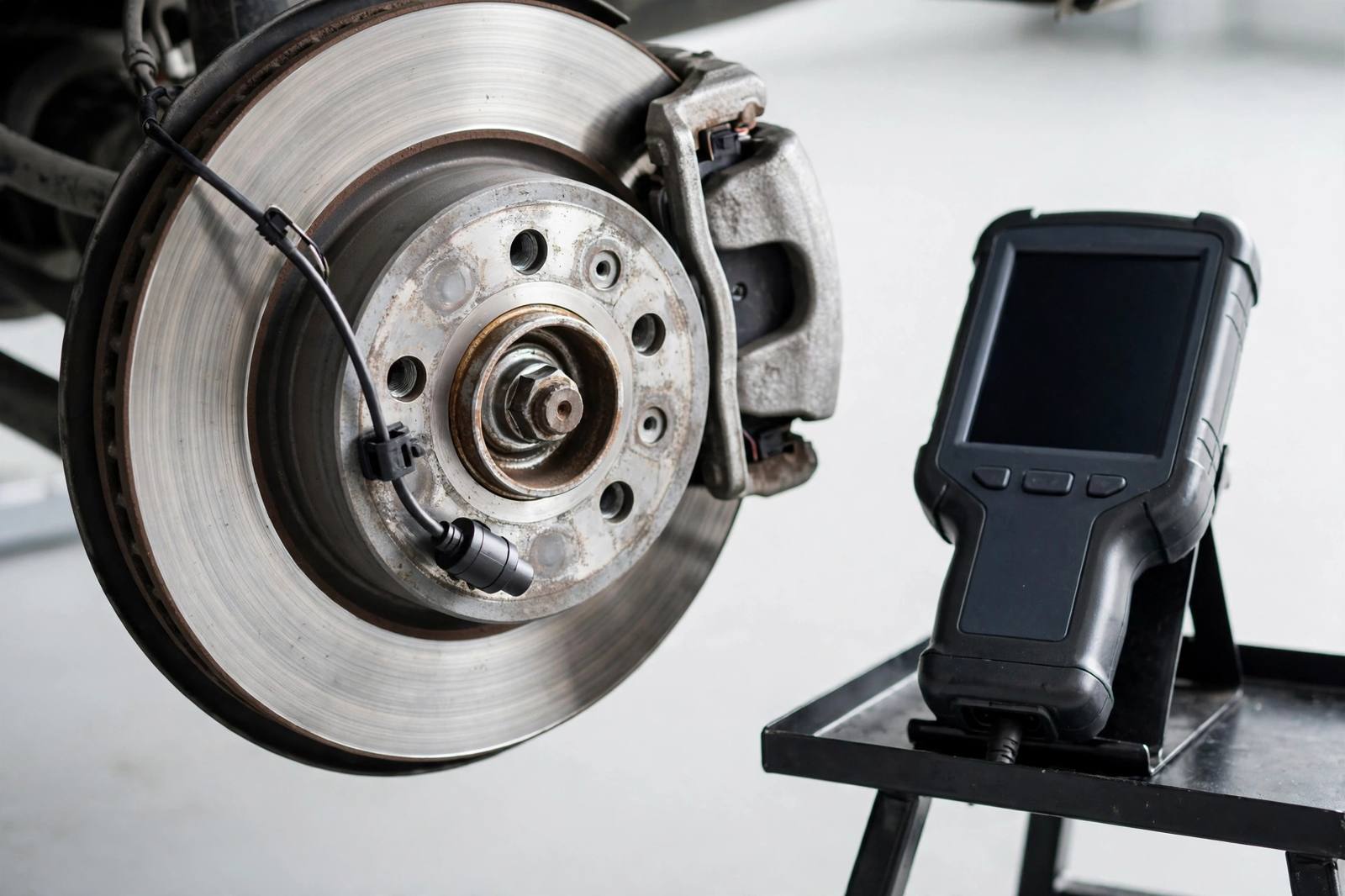
US$173 to US$230. That is RepairPal's average cost for a wheel speed sensor replacement on a 2010 Grand Caravan, checked November 15, 2026, and it is money owners regularly spend on the wrong corner, or on a healthy sensor whose wire had corroded. The van carries one sensor at each wheel hub, each reporting its wheel's speed to the ABS control unit. A bad sensor is one of the leading causes of the ABS warning light, because the sensors live close to the wheels in the harshest environment on the van. But the same light, and sometimes the same code, can come from a low tire, low brake fluid, a blown fuse, damaged wiring, or a failing ring the sensor reads. The code names a corner. It does not name a part, and this guide works in that order.
Before the scan tool: three free checks
- Tire pressures, all four. Low pressure in one wheel shrinks that wheel's diameter, so it spins faster than the others. When the control module sees the speed difference, it can set an ABS fault code for that wheel's speed sensor, and the TPMS light may be on alongside. Inflating a tire is a cheaper fix than a sensor.
- Brake fluid level. Excessively low fluid can trigger the ABS light. The level should sit near the high marking on the reservoir. If it is low, the cause matters more than the top up: the common reasons are worn brake pads, worn rotors, and a leak, so check pad and rotor condition and look for fluid at the wheels.
- The ABS fuse. A blown fuse or bad relay can stop the ABS system functioning. The fuse location is shown on the fuse box cover or in the owner's manual, and a blown fuse is replaced with one of the same amp rating.
Read the code, then watch all four wheels
Connect a scanner and read the ABS codes. One requirement catches owners out: the reader must be able to read ABS codes, and not all readers can, so a clean result from a basic engine code reader proves very little. The code tells you which corner the module is complaining about, and a faulty sensor cannot usually be identified by physical inspection, which is why the next step is data, not disassembly.
- Open the live wheel speed data for all four wheels on the scanner.
- Have a helper drive while you watch the screen. Never watch the data and drive at the same time.
- Start at about 10 to 20 km/h and raise speed slowly, on a straight road.
- Read the pattern. Healthy: on a straight line the four wheel speeds stay within about 1 to 2 km/h (0.6 to 1.2 mph) of each other. Faulty corner: one wheel's speed drops to zero or jumps around while the other three hold steady.
What success looks like at this stage: the live data and the stored code point at the same corner, and that corner's reading misbehaves while the other three agree. That is a proven corner. A code alone is only a suspect.
At the proven corner: wire, plug, tip, ring
A sensor can be working perfectly while its signal never arrives: the wiring and connectors at the affected wheel should be physically inspected for damage and corrosion before the sensor is replaced. Work through the corner in this order:
- Unplug the sensor connector and inspect the pins for corrosion, water, or a pin pushed back, and follow the wire for rubbed or damaged insulation.
- Look at the sensor tip for metal filings stuck to it, one of the documented failure causes alongside internal damage and a broken wire.
- Inspect the toothed or magnetic ring the sensor faces for rust or damage. If one wheel's speed is always off by a set amount rather than dropping to zero, check for mismatched tire sizes or a damaged ring before blaming the sensor.
- Only when the wire, plug, tip, and ring all pass does the sensor itself stand convicted.
When the code and the live data disagree
One documented Grand Caravan case breaks the usual rule, and it is worth knowing before it costs you a sensor. A 2003 van with 122,000 miles stored a right rear wheel speed sensor no signal code, while the live data showed the left rear wheel stuck at 0 mph. The expert's answer: that scan tool had a software bug that swapped the two rear wheels in the data display, and the code was the one to trust. His resolution test is the keeper:
- Watch the live data with the van safely raised or per the tool's procedure.
- Unplug the left rear sensor.
- If the right rear reading also drops to zero, the right rear is the actual problem corner, and the data display was swapped.
The general lesson travels beyond one tool: when code and data name different corners, prove the corner with the unplug test instead of buying the part either one suggests.
Replacing the sensor, and the decision table
Replacement at a proven corner is modest work: the sensor usually comes out with one bolt. If it is rusted into its bore, penetrating oil and gentle prying free it, and the new sensor's wire is routed along the original path so it cannot rub or snag. The stability control light may be on alongside the ABS light, since stability control works with the ABS system; both should clear when the signal is restored.
| Finding | Verdict |
|---|---|
| One low tire, code for that corner | Inflate to placard pressure and retest before buying anything |
| Code and live data agree on one corner; wiring, plug, and ring pass | Replace that corner's sensor |
| Corroded plug or damaged wire at the coded corner | Repair the wiring first; the sensor may be healthy |
| Code and data name different rear corners | Run the unplug test; trust its result over either display |
| New sensor fitted, light returns, low speed ABS activation on its own | The ABS module or pump branch: control units typically last at least 100,000 miles, but this is now the suspect, and it is a shop diagnosis |
Verify: four wheels agreeing, light out
- Clear the codes with the scanner.
- Repeat the live data drive: all four wheel speeds within about 1 to 2 km/h of each other on a straight line, with no dropouts at the repaired corner.
- Confirm the ABS light is out. It should disappear once the fault is fixed; if it does not go out immediately, driving a few miles should complete it.
- Make one firm stop from moderate speed on an empty, dry road and confirm straight, even braking with no pedal kickback at crawl speed.
Four agreeing wheels and a dark ABS light mean the repair is verified, not just installed.
Owner information only, not professional mechanical advice. Braking systems are safety critical; if any check here is beyond your tools or confidence, a shop diagnosis at the proven corner is the right spend.
— Owen Park, Automotive Writer